



Wanna explore craft careers?
Take a look at our Construction Careers page. Explore job descriptions, wage scales, working conditions, and more!

Helping someone decide?
As a parent, mentor, or just a friend, if you looking to help someone decide the next step in their career, or simply start a career, check out these helpful resources.

Which craft is right for you?
Take our quiz and find out! After a few questions and videos, you’ll find out which construction sector is your best fit.
Got some questions? Lets get started.
What is Apprenticeship?
Registered apprenticeships are state-approved programs that teach you a skilled trade while you get paid. It’s called “earn while you learn.” Think of it like this: in college, you shell out thousands to sit in a classroom, hoping it pays off later. In an apprenticeship, you skip the debt, learn on the job, and collect a paycheck while you’re at it.
Most of your training is on-the-job training (OJT) where you work for a construction company and more experienced workers teach you their craft. The other portion is classroom training called “related training.” Here, you spend some time in the classroom honing your skills in math, safety, blueprints, and many other subjects.
Instead of attending lectures for four years, you’re out in the field getting your hands dirty and building real skills that matter. No giant lecture halls, no theory, just solid experience that pays. And when you’re done, you don’t walk away with a piece of paper—you earn your Journeyman card. It’s a nationally recognized credential that proves you know your craft and can hold your own on any job site.
What is Pre-Apprenticeship?
A pre-apprenticeship is a stepping stone into a registered apprenticeship; it’s a hands-on program that gets you ready for the job site, not just the classroom. You’ll learn the basics that matter: hand and power tool basics, safety, job-site math, and how to move with confidence while on the job. In Oregon, these programs are backed by the Bureau of Labor & Industries (BOLI) and follow state-approved training that actually sets you up for success. It’s the foundation you need to hit the ground running in a registered apprenticeship.
Is registered apprenticeship the only pathway?
We’re big fans of registered apprenticeship, but it’s not the only way to break into construction. Plenty of companies train their own people from the ground up—no official “registered apprenticeship” label required. That kind of hands-on, learn-as-you-go setup is what we call craft training. If you want to get into construction but take a different path, this might be your move. You can start out as a laborer, carpenter, or materials handler—whatever gets you on the site and in the game. Not every business uses the apprenticeship system, and that’s okay. If you know a local company that doesn’t, pick up the phone and ask if they’re hiring. Everyone starts somewhere; what matters is getting your foot in the door and learning the trade.
Entry-level roles could be laborer, carpenter, materials handler, landscaper, and many more. Starting in any of these roles and moving up is another excellent way to start your construction career. Especially since not all businesses use registered apprenticeship. If you know of a local small business that doesn’t work with registered apprenticeship, don’t worry! Call them up and see if they are hiring any entry-level roles.
Are there college programs for construction?
Construction isn’t just about swinging hammers and pouring concrete—it needs college grads too. Sure, the craft workers build it, dig it, and weld it, but every job site also needs people calling the shots and keeping things running behind the scenes. Roles like estimator, project manager, project engineer, and safety manager can all start with a college pathway. So, if you want to be part of the construction world but you’re more about strategy than steel-toed boots, this route is for you.
Oregon’s got some solid options for that: Oregon State University’s Construction Engineering Management program is top-notch, and Oregon Tech’s Construction Management degree through the College of Business is a strong contender too. Both open doors to leadership roles in the industry; it’s just a matter of which path fits your style.
Are there different kinds of construction?
Yes! There are all kinds of construction work. We break the whole industry into 4 big sectors, each one has a unique scope of work and set of challenges and benefits.
Vertical
This is probably what comes to mind when you hear “construction.” It’s the big stuff—houses, offices, schools, libraries—anything built from the ground up. That’s why we call it vertical. If shaping skylines and watching something real rise from dirt and steel sounds like your kind of work, you’ve found your lane.
Vertical construction takes a full crew of skilled trades to pull off: carpenters, roofers, electricians, ironworkers, brick masons, and plenty more. Every trade has a hand in bringing a building to life. The opportunities are endless.
Finish Work
If you’ve got an eye for detail or a knack for turning hard work into art, this is where you’ll shine. The finish trades are the ones who bring a project to life—adding the final touches that make a building stand out. Think custom fireplace mantels, polished hardwood floors, and tilework sharp enough to stop someone in their tracks. This is where craftsmanship meets creativity, and every cut and brushstroke matters.
Trades in this world include flooring installers, tile setters, painters, drywall finishers, and more—the artists who give every build its final edge.
Mechanical
If you’re the kind of person who likes figuring out how things work, this is your zone. We’re talking gears, motors, pipes, and wires. The stuff that keeps everything moving, lit, and alive. Remember sitting in math class wondering when you’d ever use that stuff? Here’s your answer. The people who keep our power on, our water running, and our machines humming use math every single day—and they make it pay.
Trades in this world include electricians, plumbers, HVAC techs, diesel mechanics, and more—the ones who keep the heart of every job site beating.
Heavy Civil
Highways, bridges, parking lots, interstates—this is the big league. Heavy civil construction builds the backbone of our cities and towns: the roads we drive, the bridges we cross, the infrastructure we rely on every day. If running big yellow iron, moving tons of material, or keeping the wheels of a city turning sounds like your kind of work, you’ve found your sector.
Trades here include operating engineers, pile drivers, laborers, ironworkers, and plenty more—the folks who lay the foundation for everything around us.
Not sure where you belong?
We can help. Take our Trades Quiz and get results on what sector and trades best fit you!
Is Construction a Good Industry to get into?

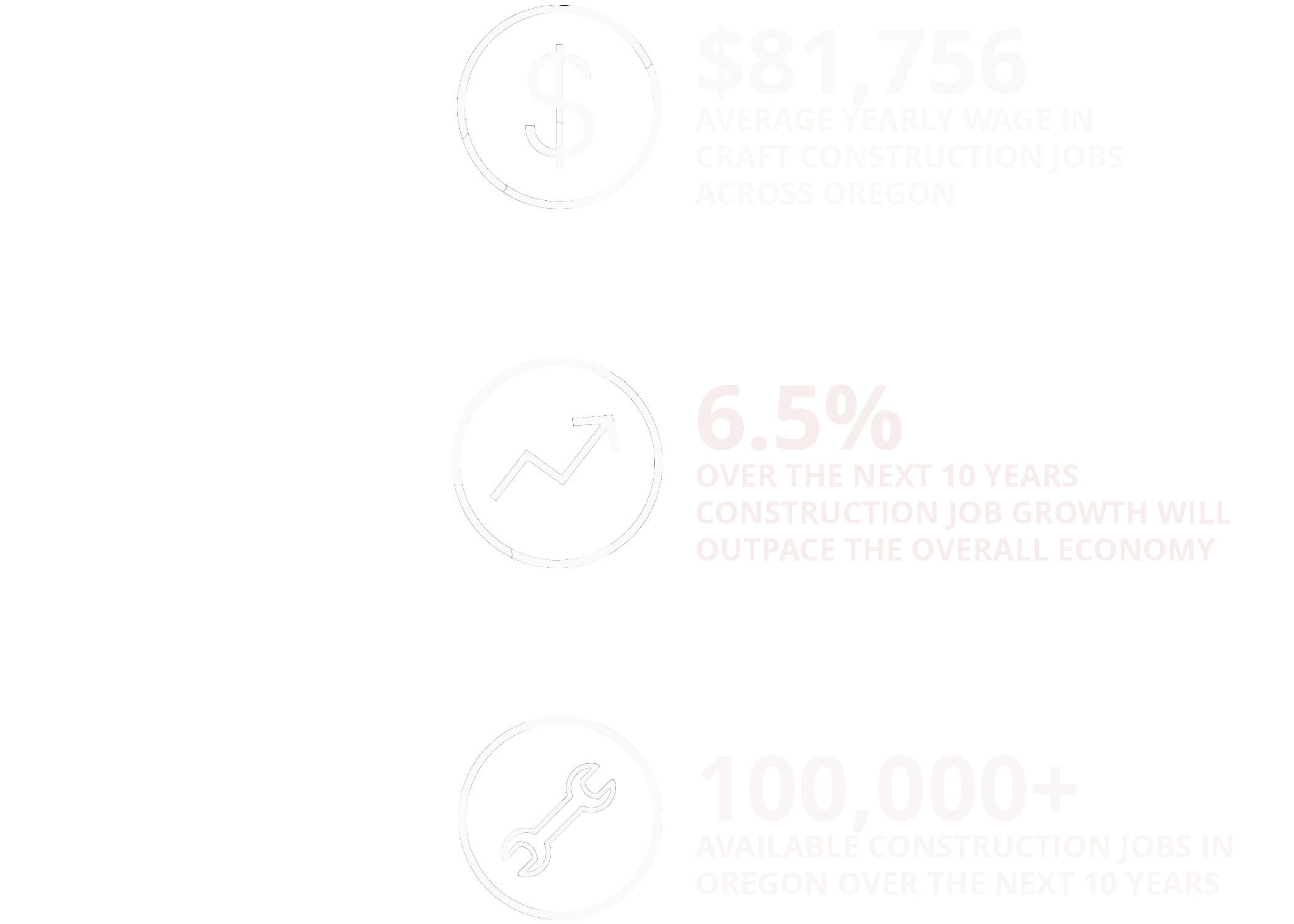
Absolutely. Construction pays—well. And the pay isn’t slowing down anytime soon. More homes, buildings, and roads need to go up every year, which means more jobs, more opportunities, and more money in your pocket.
Some careers fade away…seen a carriage driver lately? But here’s the thing: as long as people need buildings, roads, and housing, there will be work for those willing to pick up a hammer, climb a scaffold, or run the machines that make it happen.